Anisotropic Elements
The anisotropic example is a singularly perturbed reaction-diffusion problem,
where boundary layers make stretched elements useful. The embedded Trefftz point is that the local residual tests do not need to be the full tensor-product trial space. We keep the DG trial space, but test the residual with a compact anisotropic tensor-product space.
Stability Picture
The analysis asks for two independent stability mechanisms: must be well-posed on , and the local maps must control the lifting component,
For variable coefficients and anisotropic test spaces, the analysis often starts with a prototype operator and treats the actual operator as a perturbation. On the lifting space, assume
Then the local lifting solve remains stable. Geometrically, the Trefftz space rotates inside the polynomial space, but it does not collide with the chosen lifting complement.
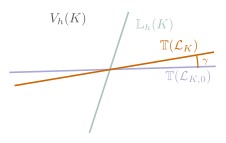
For Laplace, and recover harmonic polynomials because .
The TP0 Constraint Space
On the element , the TP0 tests vanish on the two long edges
That choice gives local constraints and leaves embedded Trefftz unknowns per quadrilateral.
Source
import math

import matplotlib.pyplot as plt
import netgen.meshing as ngm
from netgen.geom2d import SplineGeometry
from ngsolve import *
from ngsolve import TensorProductTools
from ngsolve_book import Draw
from ngstrefftz import *
SetNumThreads(4)

Lap = lambda u: sum(Trace(u.Operator("hesse")))


def make_tensor_product_mesh(mesh1, mesh2):
    ngmesh = TensorProductTools.MakeTensorProductMesh(mesh1, mesh2)
    for el in ngmesh.Elements1D():
        if el.index < 1:
            el.index = 1
    return ngmesh


def graded_line_mesh(n, sigma):
    ngmesh = ngm.Mesh(dim=1)
    pids = []

    c = 1 - math.exp(-1 / sigma)
    left = [-1 - sigma * math.log(1 - c * (i + 1) / (n + 1)) for i in range(n)]
    right = [1 + sigma * math.log(1 - c * (i + 1) / (n + 1)) for i in range(n - 1, -1, -1)]
    points = [-1] + left + right + [1]

    for xi in points:
        pids.append(ngmesh.Add(ngm.MeshPoint(ngm.Pnt(xi, 0, 0))))

    TensorProductTools.AddEdgeEls(0, 1, 1, len(points) - 1, pids, ngmesh)
    ngmesh.Add(ngm.Element0D(pids[0], index=1))
    ngmesh.Add(ngm.Element0D(pids[-1], index=2))
    ngmesh.SetBCName(0, "left")
    ngmesh.SetBCName(1, "right")
    return ngmesh
We can see the constraint space directly on a graded tensor-product mesh.
meshx = Mesh(graded_line_mesh(1, sigma=0.2))
mesh = Mesh(make_tensor_product_mesh(meshx, meshx))
tp0_fes = TP0FESpace(mesh, order=2)
up = GridFunction(tp0_fes, multidim=tp0_fes.ndof)

for i, vec in enumerate(up.vecs):
    vec.data[:] = 0
    vec.data[i] = 1

Draw(up,mesh,"basis",animate=True,interpolate_multidim=False,min=-1, max=1, deformation=True, scale=.3, euler_angles=[-70,0.4,2],)WebGLSceneExample 1 Recap
The square example uses the exact solution
so the layers sit on the four sides of .
Source
order = 5


eps = 4.0e-2
cosh = lambda z: (exp(z) + exp(-z)) / 2
exact = (1 - cosh(x / eps) / cosh(1 / eps)) * (
    1 - cosh(y / eps) / cosh(1 / eps)
)
rhs = -eps**2 * (exact.Diff(x).Diff(x) + exact.Diff(y).Diff(y)) + exact
sigma = (order+0.5)*eps * (3/exp(1))

meshx = Mesh(graded_line_mesh(10,sigma))
mesh = Mesh(make_tensor_product_mesh(meshx, meshx))Source
def reaction_diffusion_form(u, v, eps, alpha, alpha_bnd):
    n = specialcf.normal(2)
    h = AdjacentFaceSizeCF()
    jump = lambda z: z - z.Other()
    avg = lambda z: h / (h + h.Other()) * z + h.Other() / (h + h.Other()) * z.Other()

    form = eps**2 * grad(u) * grad(v) * dx + u * v * dx
    form += eps**2 * (-avg(grad(u)) * n * jump(v)- avg(grad(v)) * n * jump(u)) * dx(skeleton=True)
    form += alpha * jump(u) * jump(v) * dx(skeleton=True)
    form += alpha_bnd * u * v * ds(skeleton=True)
    form += eps**2 * (-n * grad(u) * v - n * grad(v) * u) * ds(skeleton=True)
    return form


def reaction_diffusion_rhs(rhs, v, eps, alpha_bnd, bndc=0):
    n = specialcf.normal(2)
    form = rhs * v * dx
    form += alpha_bnd * bndc * v * ds(skeleton=True)
    form += eps**2 * (-n * grad(v) * bndc) * ds(skeleton=True)
    return form


def solve_embedded_from_embedding(basefes, tfes, emb, order, eps, rhs):
    h = AdjacentFaceSizeCF()
    alpha = 10 * eps**2 * order**2 / (h + h.Other())
    alpha_bnd = 10 * eps**2 * order**2 / h

    gfu = GridFunction(basefes)
    with TaskManager():
        gfu.vec.data = emb.GetParticularSolution()

    ut, vt = tfes.TnT()
    a = BilinearForm(tfes)
    a += reaction_diffusion_form(ut, vt, eps, alpha, alpha_bnd)

    f = LinearForm(tfes)
    f += reaction_diffusion_rhs(rhs, vt, eps, alpha_bnd)
    minus_gfu = GridFunction(basefes)
    minus_gfu.vec.data = -gfu.vec
    f += reaction_diffusion_form(minus_gfu, vt, eps, alpha, alpha_bnd)

    with TaskManager():
        a.Assemble()
        f.Assemble()
        sol_t = a.mat.Inverse(inverse="sparsecholesky") * f.vec

    gfu.vec.data += emb.Embed(sol_t)
    return gfu
The only code to remember is the embedded Trefftz space construction:
basefes = L2(mesh, order=order, dgjumps=True)
testfes = TP0FESpace(mesh, order=order, allow_both_axes_zero=False)

u = basefes.TrialFunction()
w = testfes.TestFunction()

op = (-eps**2 * Lap(u) + u) * w * dx
lop = rhs * w * dx
emb = TrefftzEmbedding(op, lop)
tfes = EmbeddedTrefftzFES(emb)

gfu = solve_embedded_from_embedding(basefes, tfes, emb, order, eps, rhs)

print(f"error: {sqrt(Integrate((gfu - exact) ** 2, mesh)):.3e}")

Draw(gfu, mesh, "Example 1: embedded Trefftz boundary layer");
error: 3.722e-07
Curved Anisotropic Elements
For curved quadrilaterals, the paper maps the reference square first to the stretched pullback rectangle and then to the physical element:
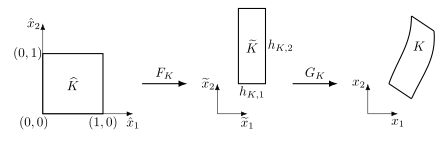
Figure 2:The TikZ picture shows the reference-to-physical mapping. The TP0 space is defined on and pushed forward by .
Example 2: Circular Boundary Layer
The circular experiment uses the unit disk and
The central disk is triangulated. The outer annulus is built from curved quadrilateral layers, graded toward the boundary layer at .
Source
def inv_polar(vx, vy):
    radius = math.sqrt(vx**2 + vy**2)
    angle = math.atan2(vy, vx)
    if angle < 0:
        angle += 2 * math.pi
    return radius, angle


def hybrid_circle_mesh(r_layer, h_inner, bnd="dirichlet", order_geom=5, deformstart=0):
    mapping = lambda theta, radius: (
        radius * math.cos(theta),
        radius * math.sin(theta),
    )
    mesh_nodes = {}

    ngmesh = ngm.Mesh()
    geo = SplineGeometry()
    geo.AddCircle((0, 0), r_layer[-1], leftdomain=1, rightdomain=0, bc=bnd)
    ngmesh.SetGeometry(geo)
    ngmesh.dim = 2

    geo_inner = SplineGeometry()
    geo_inner.AddCircle((0, 0), r_layer[1], leftdomain=1, rightdomain=0, bc="inner")
    mesh_inner = geo_inner.GenerateMesh(maxh=h_inner)

    pmap = {}
    for el in mesh_inner.Elements2D():
        for vertex in el.vertices:
            if vertex not in pmap:
                pmap[vertex] = ngmesh.Add(mesh_inner[vertex])
                point = mesh_inner[vertex].p
                mesh_nodes[pmap[vertex].nr] = (point[0], point[1])

    idx_dom = ngmesh.AddRegion("inner", dim=2)
    for el in mesh_inner.Elements2D():
        curved_el = ngm.Element2D(idx_dom, [pmap[vertex] for vertex in el.vertices])
        curved_el.curved = True
        ngmesh.Add(curved_el)

    pids_inner = []
    for edge in mesh_inner.Elements1D():
        for vertex in edge.vertices:
            point_id = pmap[vertex]
            if point_id not in pids_inner:
                pids_inner.append(point_id)

    pids_inner.sort(
        key=lambda point_id: inv_polar(
            mesh_nodes[point_id.nr][0],
            mesh_nodes[point_id.nr][1],
        )[1]
    )
    pids_inner.append(pids_inner[0])

    def make_layer(pids_start, r_end):
        nx = len(pids_start) - 1
        angles = []
        zero_count = 0
        for point_id in pids_start:
            node_coord = mesh_nodes[point_id.nr]
            angle = inv_polar(node_coord[0], node_coord[1])[1]
            if abs(angle) < 1e-13:
                angles.append(0 if zero_count == 0 else 2 * math.pi)
                zero_count += 1
            else:
                angles.append(angle)

        pids_end = []
        for j in range(nx + 1):
            x_end, y_end = mapping(angles[j], r_end)
            if j == nx:
                pids_end.append(pids_end[0])
            else:
                node_id = ngmesh.Add(ngm.MeshPoint(ngm.Pnt(x_end, y_end, 0)))
                pids_end.append(node_id)
                mesh_nodes[node_id.nr] = (x_end, y_end)

        for i in range(nx):
            elpids = [pids_start[i + 1], pids_start[i], pids_end[i], pids_end[i + 1]]
            el = ngm.Element2D(idx_dom, elpids)
            el.curved = True
            ngmesh.Add(el)
        return pids_end

    pids_next = pids_inner
    for layer_index in range(len(r_layer) - 2):
        pids_next = make_layer(pids_next, r_layer[layer_index + 2])

    for i in range(len(pids_next) - 1):
        ngmesh.Add(ngm.Element1D([pids_next[i], pids_next[i + 1]], index=1))
    ngmesh.SetBCName(0, bnd)
    ngmesh.Compress()

    mesh = Mesh(ngmesh)

    fes_p1 = H1(mesh, complex=False, order=1, dirichlet=[])
    r_h = GridFunction(fes_p1)
    r_h.vec.data[:] = 0.0
    for coord_nr, coord in mesh_nodes.items():
        r_h.vec.data[coord_nr - 1] = math.sqrt(coord[0] ** 2 + coord[1] ** 2)

    r_hrelax = GridFunction(fes_p1)
    r_hrelax.vec.data[:] = 0.0
    for coord_nr, coord in mesh_nodes.items():
        if math.sqrt(coord[0] ** 2 + coord[1] ** 2) >= r_layer[deformstart] - 1e-3:
            r_hrelax.vec.data[coord_nr - 1] = math.sqrt(coord[0] ** 2 + coord[1] ** 2)

    r_dist = sqrt(x**2 + y**2)
    theta_perfect = r_hrelax * CoefficientFunction(
        ((r_h - r_dist) * x / r_dist, (r_h - r_dist) * y / r_dist)
    )

    fes_high_order = VectorH1(mesh, order=order_geom)
    theta_h = GridFunction(fes_high_order)
    theta_h.Set(theta_perfect)
    return mesh, theta_h


def circular_mesh(order, hnr, maxh_case):
    sigma = (order + 0.5) * eps_circle * (3 / math.e)
    c = 1 - math.exp(-1 / sigma)
    graded = [-sigma * math.log(1 - c * (i + 1) / (hnr + 1)) for i in range(hnr)]

    if maxh_case == 0:
        maxh = 0.15
        layers = [0.5, 0.62, 0.74, 0.87]
    else:
        maxh = 0.09
        layers = [0.5, 0.57, 0.64, 0.71, 0.8, 0.9]

    radii = [0.0] + layers + [1 - value for value in reversed(graded)] + [1.0]
    mesh, theta_h = hybrid_circle_mesh(radii, maxh, order_geom=order, deformstart=2)
    mesh.SetDeformation(theta_h)
    return mesh, theta_h
Source
eps_circle = 10 ** (-5 / 2)
exact_circle = 1 - cosh(sqrt(x**2 + y**2) / eps_circle) / cosh(1 / eps_circle)
rhs_circle = -eps_circle**2 * (
    exact_circle.Diff(x).Diff(x) + exact_circle.Diff(y).Diff(y)
) + exact_circle


def solve_reaction_diffusion(mesh, order, eps, rhs, method):
    fes = L2(mesh, order=order, dgjumps=True)
    h = AdjacentFaceSizeCF()
    alpha = 10 * eps**2 * order**2 / (h + h.Other())
    alpha_bnd = 10 * eps**2 * order**2 / h

    if method == "dg":
        gfu = GridFunction(fes)
        u, v = fes.TnT()
        a = BilinearForm(fes)
        a += reaction_diffusion_form(u, v, eps, alpha, alpha_bnd)
        f = LinearForm(fes)
        f += reaction_diffusion_rhs(rhs, v, eps, alpha_bnd)
        with TaskManager():
            a.Assemble()
            f.Assemble()
            gfu.vec.data = a.mat.Inverse(inverse="sparsecholesky") * f.vec
        return gfu, fes

    basefes = L2(mesh, order=order, dgjumps=True)
    testfes = TP0FESpace(mesh, order=order, allow_both_axes_zero=False)
    u = basefes.TrialFunction()
    w = testfes.TestFunction()
    op = (-eps**2 * Lap(u) + u) * w * dx
    lop = rhs * w * dx
    emb = TrefftzEmbedding(op, lop)
    tfes = EmbeddedTrefftzFES(emb)
    gfu = solve_embedded_from_embedding(basefes, tfes, emb, order, eps, rhs)
    return gfu, tfes
Source
preview_mesh, _ = circular_mesh(order=5, hnr=6, maxh_case=1)
preview_gfu, preview_fes = solve_reaction_diffusion(
    preview_mesh,
    order=5,
    eps=eps_circle,
    rhs=rhs_circle,
    method="embt",
)

print(f" error: {sqrt(Integrate((gfu - exact) ** 2, mesh)):.3e}")

Draw(preview_gfu, preview_mesh, "Example 2: embedded Trefftz on circular mesh");
error: 3.722e-07
The convergence loop uses the fine initial circular mesh, polynomial orders , DG and embedded Trefftz, and eight radial layer refinements. We measure the plain error.
Source
def run_circular_convergence(order_values=(4, 5), hnr_values=range(1, 9)):
    rows = []
    for order in order_values:
        for hnr in hnr_values:
            mesh_case, _ = circular_mesh(order, hnr, maxh_case=1)

            for method in ("embt", "dg"):
                gfu, fes = solve_reaction_diffusion(mesh_case,order=order,eps=eps_circle,rhs=rhs_circle,method=method,)
                l2error = sqrt(Integrate((gfu - exact_circle) ** 2, mesh_case))
                rows.append({"method": method,"order": order,"hnr": hnr,"ndof": fes.ndof,"l2error": float(l2error),})
    return rows

circular_results = run_circular_convergence()
Source
styles = {
    "dg": {"color": "#2a6fbb", "marker": "o", "label": "DG"},
    "embt": {"color": "#d95f02", "marker": "s", "label": "Embedded"},
}

fig, axes = plt.subplots(1, 2, figsize=(10, 4.2), constrained_layout=True)
for order, ax in zip((4, 5), axes):
    for method in ("dg", "embt"):
        points = [
            row
            for row in circular_results
            if row["method"] == method and row["order"] == order
        ]
        points.sort(key=lambda row: row["ndof"])
        style = styles[method]
        ax.loglog(
            [row["ndof"] for row in points],
            [row["l2error"] for row in points],
            marker=style["marker"],
            color=style["color"],
            linewidth=2.0,
            markersize=5,
            label=style["label"],
        )

    ax.set_title(rf"fine initial mesh, $p={order}$")
    ax.set_xlabel("degrees of freedom")
    ax.grid(True, which="both", linestyle=":", linewidth=0.7)
    ax.set_axisbelow(True)

axes[0].set_ylabel(r"$\|u-u_h\|_{L^2(\Omega)}$")
axes[1].legend(loc="upper right", fontsize=9)
fig.suptitle("Example: circular boundary-layer convergence")
plt.show()